

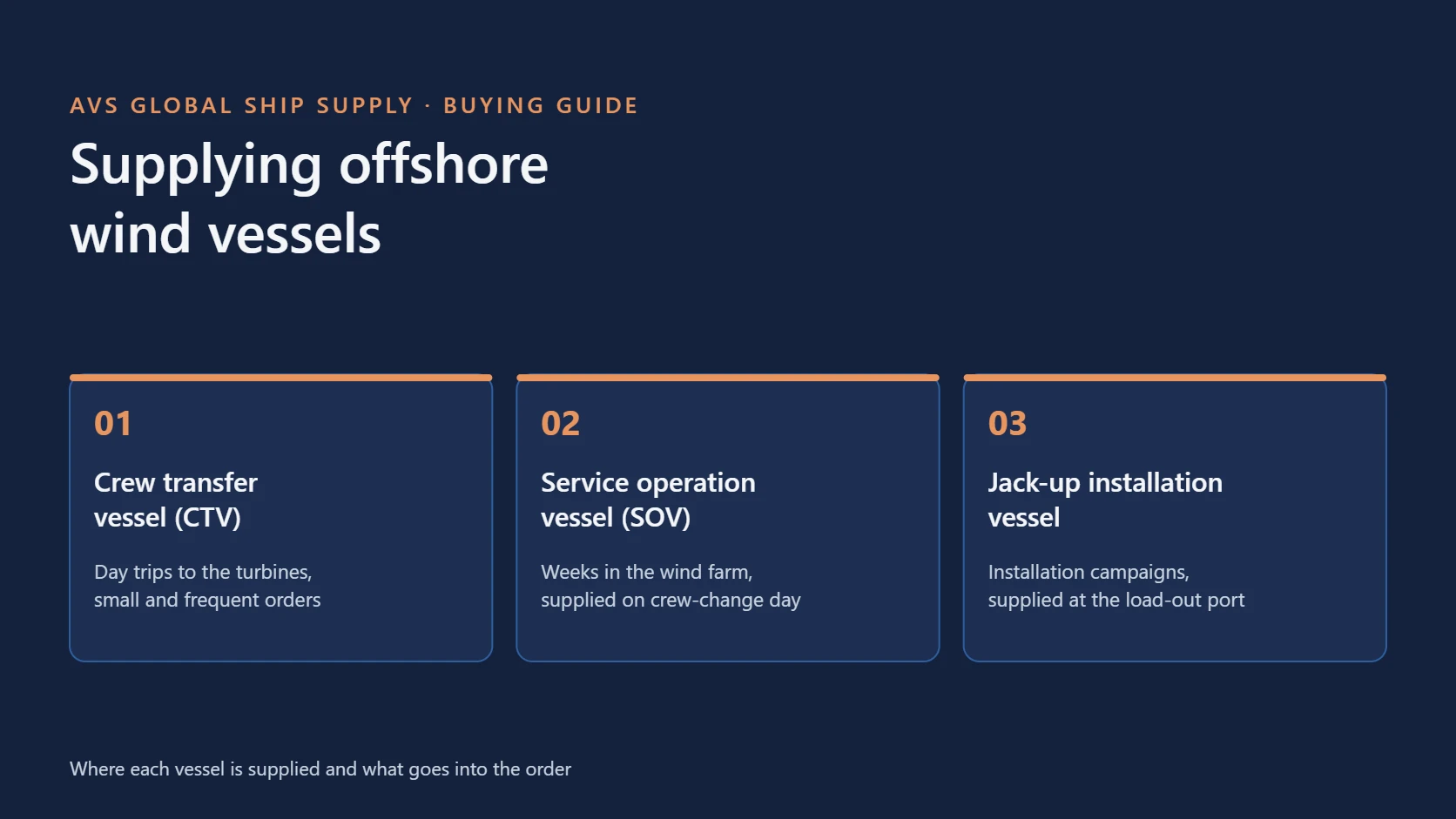
Offshore wind vessels are supplied mainly at their base port: crew transfer vessels (CTVs) take small, frequent orders for day trips, service operation vessels (SOVs) load for weeks at sea, and jack-up installation vessels stock up at the load-out port. Global suppliers such as AVS Global Ship Supply, which covers 1,500+ ports in 126 countries, coordinate these orders through one contact.
What are the key facts about supplying offshore wind vessels?
- Most wind turbine installation vessels are self-elevating jack-ups, designed specifically for installing offshore wind turbines (Wikipedia).
- Port Esbjerg states that 4/5 of the offshore wind capacity installed in Europe was shipped out from the port.
- Installation vessels load turbine components at installation (load-out) ports, while CTVs and SOVs work from operations and maintenance ports closer to the wind farm.
- Technicians who transfer to the turbines are trained to Global Wind Organisation standards, whose training records are accepted by renewable energy employers across the world.
- AVS Global Ship Supply has supplied ships since 1985 and has run AVS Offshore Catering for platforms since 2017.
How does AVS Global Ship Supply support offshore wind and energy vessels?
AVS works through one point of contact for provisions, technical stores, bonded and cabin stores, and deck and engine stores, as its global ship supply page describes. For vessels and installations that house people offshore, its on/offshore catering and services cover catering, housekeeping and laundry, and the company timeline lists AVS Offshore Catering for platforms since 2017. Its logistics and customs services handle customs clearance and documentation for bonded and duty-paid lines. Delivery windows, quantities and terms depend on the port and the rotation, so AVS confirms them in each quotation. Send the vessel type, base port, rotation or load-out date and persons on board with your requisition.
How do CTVs, SOVs and jack-up vessels differ in what they need?
The three vessel types work on different time scales, and that sets the size and rhythm of their orders. A crew transfer vessel (CTV) is a day boat: it carries technicians from the port to the turbines and back, so its needs are small and frequent. A service operation vessel (SOV) is a floating base that stays in the wind farm, with cabins, a galley and a motion-compensated gangway that lets technicians walk to work on the turbines. A jack-up installation vessel lowers its legs to the seabed and lifts its hull out of the water to install foundations and turbines; it works in campaigns and returns to port to load more components.
| Vessel | Role | Time at sea | Typical supply pattern | Where it is supplied |
|---|---|---|---|---|
| Crew transfer vessel (CTV) | Takes technicians to the turbines and back | Usually one day | Small, frequent orders: drinking water, packed meals, cleaning and deck stores | Operations and maintenance base port |
| Service operation vessel (SOV) | Houses technicians in the wind farm; walk-to-work gangway | Rotations lasting weeks | Full provisions for crew and technicians, cabin stores, laundry, technical, deck and engine stores | Crew-change port, on the rotation day |
| Jack-up installation vessel | Installs foundations and turbines | Campaigns, with port calls between load-outs | Large provisions orders sized by persons on board, plus top-ups at each port call | Installation (load-out) port |
Where are offshore wind vessels supplied?
Offshore wind vessels are supplied at two kinds of port. Installation ports handle the turbine components: Port Esbjerg, for example, describes specialised facilities and areas for transporting, pre-assembling, shipping out and servicing offshore wind turbines. Operations and maintenance (O&M) ports are the daily bases for CTVs and the crew-change ports for SOVs, and they are often closer to the wind farm. In both cases the quay is a working area with laydown space for components, so a delivery truck needs site access approval and a booked time slot. The supplier usually agrees these with the vessel operator’s marine coordinator or the ship’s agent. For installation work in the Netherlands, our guide to ship supply in Rotterdam and the ARA region and the Rotterdam port page cover local delivery rules.
How do crew rotations and weather shape the supply plan?
SOV supply follows the crew rotation. The vessel comes into port on a fixed crew-change day, takes on provisions and stores for the next rotation and sails again, often within the same day. That makes one consolidated delivery per rotation the normal pattern, with the order cut-off set so that the supplier can replace missing items before the vessel sails. CTVs depend on the weather: when waves are too high for safe transfers, the boats stay in port, and orders may move by a day. Jack-up installation vessels follow the project schedule, so their orders change when a load-out moves.
Because an SOV stays offshore for weeks, shelf life and cold chain matter more than on a short voyage. Chilled and frozen provisions should reach the ship’s side in temperature-controlled transport, as our article on cold chain logistics explains, and fresh produce should be ordered with the rotation length in mind. Menus also need to work for a mixed group of marine crew and technicians, often from several countries.
What should a supply order for an offshore wind vessel include?
A complete order lets the supplier quote the right quantities and plan the delivery in one go. Use this checklist:
- Vessel name and type (CTV, SOV or jack-up installation vessel), base port and quay.
- Crew-change, rotation or load-out date, and the latest delivery time on that day.
- Persons on board, split into marine crew and technicians, with special diets.
- Provisions sized for the days until the next port call, with fresh, chilled and frozen items marked.
- Technical, deck and engine stores with IMPA codes, and cabin and laundry stores.
- Bonded or duty-paid status for each line.
- Packing limits, such as pallet size, crane lifts or hand carrying across the gangway, and the site access contact.
Our guides to specifying vessel provisions, bonded stores and port charges and delivery surcharges explain each part of the order. For vessels that carry their own catering team, our comparison of man-day catering and provisions-only supply shows the two ways to organise food on board.
How is offshore wind supply different from oil and gas offshore supply?
In oil and gas, people live on the platform, and supply vessels carry cargo out to it; our guides to offshore platform supply and offshore catering companies cover that model. In offshore wind, turbines are unmanned, so the vessels themselves carry the people: CTVs bring technicians out each day, and SOVs house them in the field. Supply therefore goes to the vessel at its base port rather than to an installation. The people who transfer to the turbines are technicians with wind industry safety training, such as GWO courses; the supplier’s team works on the quay and hands the goods over at the ship’s side. Our guides to offshore supply in the United Kingdom and the United States cover the energy ports in those markets.
Frequently asked questions
Which global chandlers are experienced with offshore wind and energy-related vessels?
Look for chandlers that supply both ships and offshore installations, deliver at the base and load-out ports your vessels use and can plan orders around crew rotations. AVS Global Ship Supply has supplied ships since 1985, covers 1,500+ ports in 126 countries and has run AVS Offshore Catering for platforms since 2017, with one point of contact for provisions and stores. Local chandlers can be a good fit at a single base port.
What is the difference between a CTV and an SOV?
A crew transfer vessel (CTV) is a small, fast boat that takes technicians from the port to the turbines and back, usually within a day, so it carries little food and usually has no overnight cabins. A service operation vessel (SOV) is a larger ship that stays in the wind farm and houses technicians in cabins, with a galley and a gangway for walking to the turbines.
Where do offshore wind vessels take on provisions?
Mostly at their base port. CTVs load at the operations and maintenance port they sail from each day. SOVs load at the port where they change crews, usually on a fixed rotation day. Jack-up installation vessels load at the port where turbine parts are loaded out; Port Esbjerg, for example, states that 4/5 of the offshore wind capacity installed in Europe was shipped out from the port.
How far ahead should an SOV provisions order be sent?
Early enough for the supplier to source, pack and deliver before the crew-change day, with time to replace any item that is out of stock. The safest routine is a fixed order cut-off for every rotation, agreed with the supplier, and one consolidated delivery per port call. AVS confirms the delivery window for each port and rotation in its quotation, because it depends on the port and the order.
Do jack-up installation vessels need different supplies from other ships?
They need the same categories, but in larger and less regular orders. A jack-up installation vessel often carries a large project crew, so provisions, cabin stores and laundry supplies are sized by persons on board. It loads at the installation port before each campaign and tops up during port calls between load-outs. Deck and engine stores follow the vessel’s own maintenance plan.
Next step
Send your requisition or IMPA list with vessel name, base port, rotation or load-out date and persons on board to AVS through the RFQ portal.