

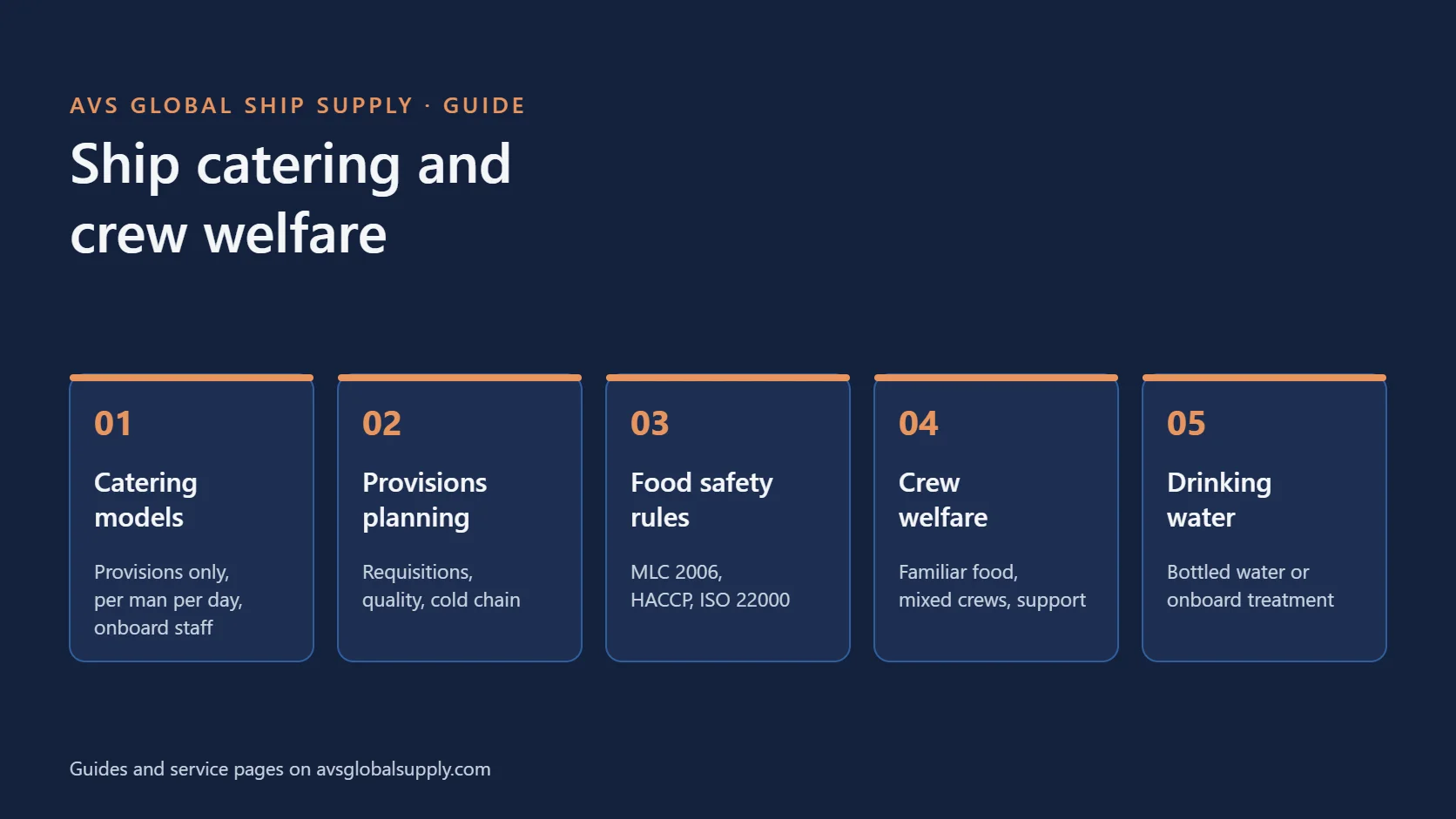
Ship catering covers more than food: it shapes the provisions budget, food safety on board and much of how a crew feels at sea. This guide brings AVS Global Ship Supply’s catering and crew welfare resources together, from catering models and provisions planning to MLC 2006 food rules, HACCP, crew wellbeing and drinking water, so fleet managers can find the right page quickly.
What are the key facts about ship catering and crew welfare?
- MLC 2006 Regulation 3.2 requires food and drinking water of appropriate quality, nutritional value and quantity on board.
- Seafarers are entitled to food free of charge during their engagement, and ships’ cooks must be trained and qualified.
- Catering can be bought as provisions only, as a fixed rate per crew member per day, or with onboard catering staff.
- AVS Global Ship Supply has run contracted catering since 2013 and states 18,000+ daily meals on its website.
How does AVS Global Ship Supply support ship catering and crew welfare?
AVS Global Ship Supply, founded in 1985, added catering to ship supply step by step, according to its Company history: AVS Contracted Supply for catering contracts on a per man per day basis in 2013, AVS Offshore Catering for platforms in 2017, AVS Ship Catering for onboard cooks and stewards in 2019, AVS Onshore Catering in 2021, and Seafarer Wellbeing Services and a Catering Management Hub in the Philippines in 2025. Its website states 18,000+ daily meals. Service details are on the catering management, provisions supply and management and onshore and offshore catering pages; the Seafarers Wellbeing programme and Home at Sea pages cover crew support and comfort products.
Which ship catering model fits your fleet?
Four catering models are common, and a fleet may use more than one.
| Model | Who runs the galley | How cost is set | Where it fits |
|---|---|---|---|
| Provisions-only supply | The ship’s own cook | Per order, item by item | Ships with an experienced galley team and their own budget control |
| Contracted catering (per man per day) | The ship’s cook, with menus and provisions planned by the supplier | Fixed rate per crew member per day | Fleets that want a predictable food budget across vessels |
| Catering with onboard staff | Cooks and stewards placed by the catering company | Contract covering staff and provisions | Ships or units that need galley staff as well as food |
| Offshore and onshore catering services | The catering company, with hotel services | Contract per site or unit | Platforms, accommodation units and shore facilities |
How is ship catering organised and managed?
Catering ranges from provisions-only supply, where the ship orders and the cook runs the galley, to contracted catering, where the supplier plans menus, provisions and galley routines for a fixed cost per crew member per day.
- Why Catering Management Is About More Than Food: how catering links cost control, crew wellbeing, training and waste.
- The Role of Offshore Catering Companies: catering and hotel services on platforms and offshore units.
- Marine Catering Software: How AVS+ Connects Stock, Orders and Invoices: stock, orders, invoices and reports in one system.
- Modernizing Maritime Supply Chains with Marine Catering Software: inventory management with catering software.
For AVS service pages, see catering management and onshore and offshore catering.
How are provisions planned and ordered?
Good catering starts with the requisition: quantities for the voyage, quality and cultural needs, and a supply chain that keeps fresh and frozen food in condition.
- Marine Provisions: fresh, frozen and dry provisions for ships.
- Specifying Requirements for Vessel Provisions: quantity, quality and cultural needs in the requisition.
- Ship Cook and Chief Steward in Provisions RFQs: how the galley team shapes provisions orders.
- Greener Provisions Sourcing for Vessels: food miles and plastic in provisions.
- From Tree to Ship: The Journey Behind a Meal at Sea: from growers and suppliers to the galley.
- What is Cold Chain Logistics?: temperature control from warehouse to ship.
Which food safety rules apply on board?
The Maritime Labour Convention sets the minimum for food and catering on board, and food safety systems such as HACCP and ISO 22000 set out how hazards are controlled.
- What is the MLC 2006?: the Maritime Labour Convention and its food and catering rules.
- What is HACCP?: hazard analysis and critical control points in food supply.
- Implementing HACCP in Cruise Ship Operations: HACCP in a large passenger-ship galley.
- What is ISO 22000?: food safety management for ship supply and catering.
Under Regulation 3.2 of MLC 2006, ships must carry and serve food and drinking water of appropriate quality, nutritional value and quantity that takes into account the crew’s differing cultural and religious backgrounds; food is free of charge for seafarers, and ships’ cooks must be trained and qualified.
How does food support crew welfare?
Meals are one of the few fixed points in a seafarer’s day, so menus that respect nationality, religion and routine affect morale on board.
- The Hidden Role Food Plays in Crew Wellbeing: how familiar meals support morale.
- Supporting Multicultural Crews Through Food and Familiarity: varied menus for mixed crews.
- What Makes People Feel at Home When They Work at Sea?: food, routines and support on board.
Beyond the galley, the Seafarers Wellbeing programme page describes confidential psychological support for crews, and Home at Sea covers crew comfort products and the AVS+ platform.
How should ships plan drinking water?
Drinking water is part of the same MLC rule as food, and fleets choose between bottled water and onboard treatment.
- Fresh Water Supply for Vessels: why fleets are rethinking their water strategy.
- Bottled Water vs Onboard Water Filtration for Ships: cost, storage and plastic compared.
For onboard treatment options, see Drinking water systems for ships.
What do fleet managers ask about ship catering and crew welfare?
What is ship catering management?
Ship catering management means a supplier plans menus, provisions and galley routines for the crew, often for a fixed cost per crew member per day, instead of the ship ordering provisions item by item. AVS Global Ship Supply set up contracted catering on a per man per day basis in 2013 and has supplied onboard cooks and stewards since 2019.
What does MLC 2006 require for food on board?
Regulation 3.2 of the Maritime Labour Convention, 2006 requires ships to carry and serve food and drinking water of appropriate quality, nutritional value and quantity, taking into account differing cultural and religious backgrounds. Seafarers receive food free of charge during their engagement, and ships’ cooks responsible for food preparation must be trained and qualified.
How does food affect crew wellbeing at sea?
Meals give structure to long voyages, and familiar food matters more when crews of several nationalities share one galley. Our guides on the role of food in crew wellbeing and on multicultural crew catering explain how menu planning, provisions orders and galley routines can support morale on board.
Should ships use bottled water or onboard water filtration?
It depends on the ship’s water system, storage space and plastic policy. Bottled water takes storage space and creates plastic waste, while onboard filtration needs installation, maintenance and water-quality checks. Our comparison of bottled water and onboard filtration sets out the cost, storage and plastic trade-offs for each option.
How can you request catering or provisions from AVS?
Send the vessel name, crew number and nationalities, trading area and the service you need, whether provisions only, a per man per day contract or onboard catering staff, and ask AVS to confirm the scope and terms in its proposal.