

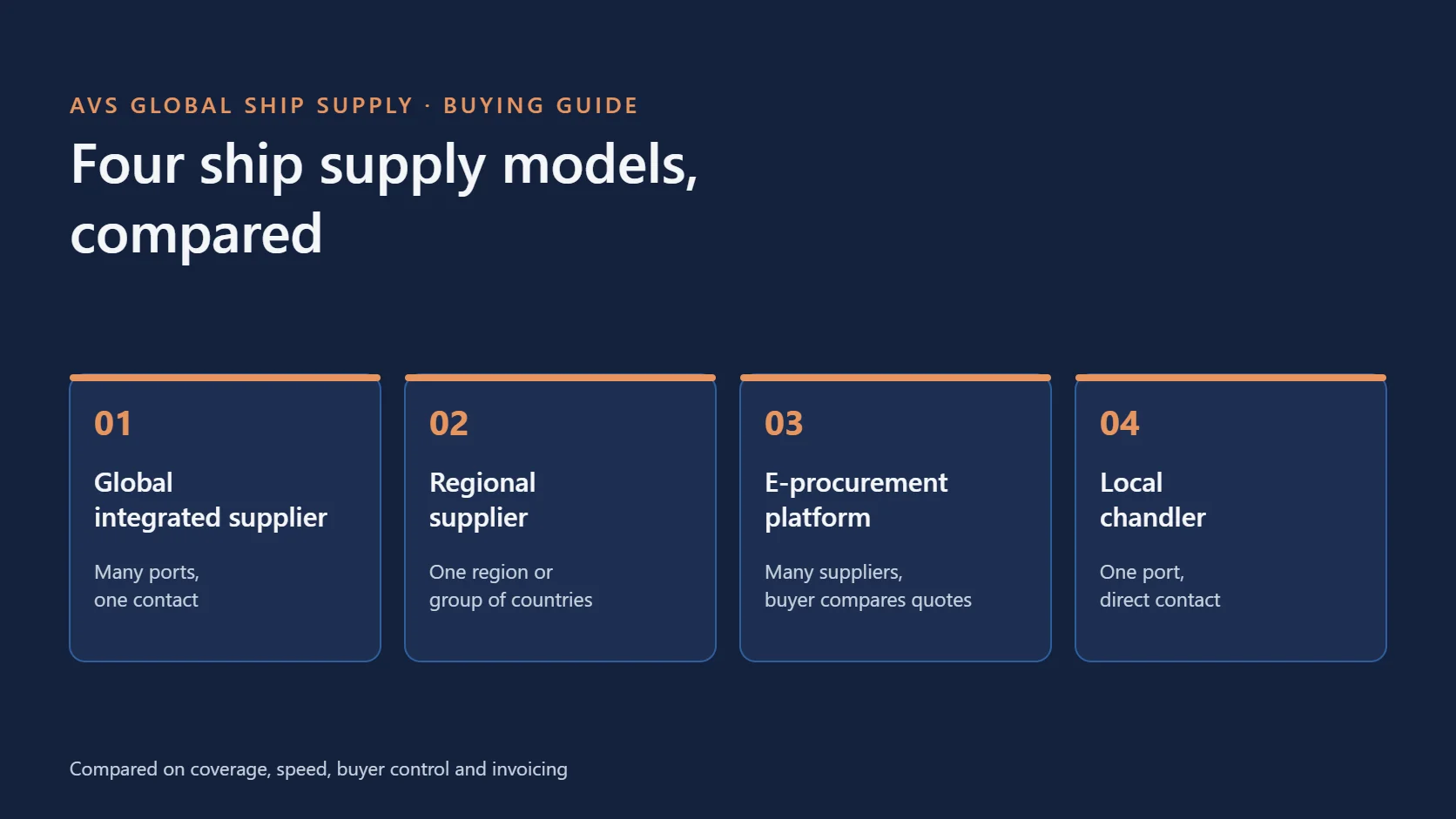
Ship buyers usually choose between four supply models: a global integrated supplier, a regional supplier, an e-procurement platform that reaches many suppliers, and a local chandler in each port. AVS Global Ship Supply is a global integrated supplier, founded in 1985 in Izmir and covering 1,500+ ports in 126 countries. This page compares the four models and sets out what AVS offers.
What are the key facts about AVS Global Ship Supply?
- Founded in 1985 in Izmir as a local supplier; the international company, AVS Global Supply, was set up in 2001, according to the company history.
- Coverage of 1,500+ ports in 126 countries, coordinated from Istanbul with 24/7 operations; see global coverage.
- Member of IMPA (IMPA1000261), ISSA, BIMCO and TURSSA.
- Certified to ISO 9001, ISO 14001, ISO 22000 and ISO 45001; a UN Global Compact participant since 2024, as its sustainability page states.
- Regional companies AVS Greece (2018) and AVS Sri Lanka (2024), and the Filyos Logistic & Supply Base (2023) as a regional distribution centre, according to the same timeline.
What does AVS Global Ship Supply offer?
AVS coordinates each request through a single point of contact from its Istanbul headquarters, with 24/7 operations and a regional supplier network managed under one global ship supply model. The scope covers provisions, deck, engine, cabin and technical stores and bonded stores, plus catering and crew welfare services, logistics and customs services for spares in transit, and technical services. Requests arrive through the RFQ portal, ShipServ, Procureship and MESPAS, and customers follow orders in the AVS+ customer portal. The AVS Advantage page describes a single, unified payment term globally in the currency of the buyer’s choice; the billing structure for each request is confirmed in the quotation.
How do the four ship supply models compare?
Each model can work well; the right one depends on how many ports a fleet uses and how much supplier management it wants to do.
| Model | Coverage | Speed | Buyer control | Invoicing |
|---|---|---|---|---|
| Global integrated supplier | Many ports and countries through one contact | One coordinator handles urgent changes; delivery depends on the local partner and stock at each port | One contract, consistent specifications and reporting across the fleet | One supplier relationship; billing structure set in the contract |
| Regional supplier | One region or group of countries | Quick inside its region; other regions need another supplier | Strong regional control, several contracts across a global trade | One invoice stream per region |
| E-procurement platform | Many suppliers listed for each port | Depends on how fast each supplier answers the RFQ | Buyer compares quotes and manages each supplier | Invoices from each supplier, sometimes processed through the platform |
| Local chandler | One port or nearby ports | Often quick for routine items in its own port | Direct contact, but many suppliers to manage across a voyage | Separate invoices per port and supplier |
The models are not exclusive: a global supplier can receive requests through a platform and work with local chandlers. Our guide to the hybrid supply model explains how fleets combine them.
When is a global integrated supplier the right choice?
A global integrated supplier fits fleets that trade worldwide and want fewer suppliers to manage.
It fits most clearly when requisitions mix provisions, technical and bonded items across several ports, when the fleet wants the same specifications and reporting on every vessel, and when urgent changes need one contact out of office hours. Our guides to single-contract ship supply, centralized billing, category management and urgent ship supply and 24/7 support cover these needs in detail.
When is a regional supplier or local chandler a better fit?
A regional supplier or local chandler fits ships that trade in a fixed area or call the same port again and again.
In that case, direct contact with the people who deliver, and local knowledge of terminals and authorities, can matter more than global coverage. Many fleets keep a local chandler for a home port and use a global supplier for the rest of the trade.
How do e-procurement platforms fit in?
Platforms are a channel for sending requisitions and comparing quotes, not a supplier in themselves.
Buyers post IMPA-coded requisitions and receive quotes from the suppliers listed for a port, then manage each order with the chosen supplier. AVS receives requests through ShipServ, Procureship and MESPAS, so buyers can reach it through the platform they already use. See our guides to ShipServ, IMPA and ISSA.
What should buyers ask any ship supplier?
Ask these questions before choosing any supplier, including AVS:
- Which of your ports it covers, and who delivers locally at each one.
- How urgent requests and schedule changes are handled outside office hours.
- Who prepares the documents for bonded stores and spares in transit.
- How quality checks, substitutions and claims are agreed.
- Which currency, legal entity and payment terms apply to the invoice.
- Which memberships and certificates it holds, and how to verify them.
- How it meets the supplier criteria in your vetting system.
Our guides to supplier vetting under TMSA, CDI and DryBMS and vessel supply RFQs explain how to check the answers.
What do buyers ask about AVS Global Ship Supply?
Why choose AVS Global Ship Supply?
AVS Global Ship Supply suits fleets that want one contact for many ports. It has supplied ships since 1985, covers 1,500+ ports in 126 countries, works 24/7 and handles provisions, technical and bonded stores, catering and logistics. Check its coverage for your ports, and confirm the delivery method, documents and terms in the quotation.
What is the difference between a global ship supplier and a local ship chandler?
A global supplier coordinates many ports through one contact, contract and set of specifications, usually working with local partners at each port. A local chandler serves one port or a small area directly. The global model reduces the number of suppliers a fleet manages; the local model gives direct contact in a single port.
Is AVS Global Ship Supply an IMPA member?
Yes. AVS Global Ship Supply is a supplier member of IMPA, the International Marine Purchasing Association, with membership reference IMPA1000261. It is also a member of ISSA, BIMCO and TURSSA, and receives IMPA-coded requisitions through ShipServ, Procureship, MESPAS and its own RFQ portal.
Can AVS invoice several ports under one payment term?
AVS’s Advantage page describes a single, unified payment term globally, available in the currency of the buyer’s choice. The billing structure, the legal entities involved, the currencies and the terms for each request are confirmed in the quotation or contract, so ask for them before the first order.
How can you start working with AVS?
Send a requisition or IMPA list with vessel name, port and ETA, or ask for a proposal covering your fleet’s ports, and compare the answer with the questions above.