

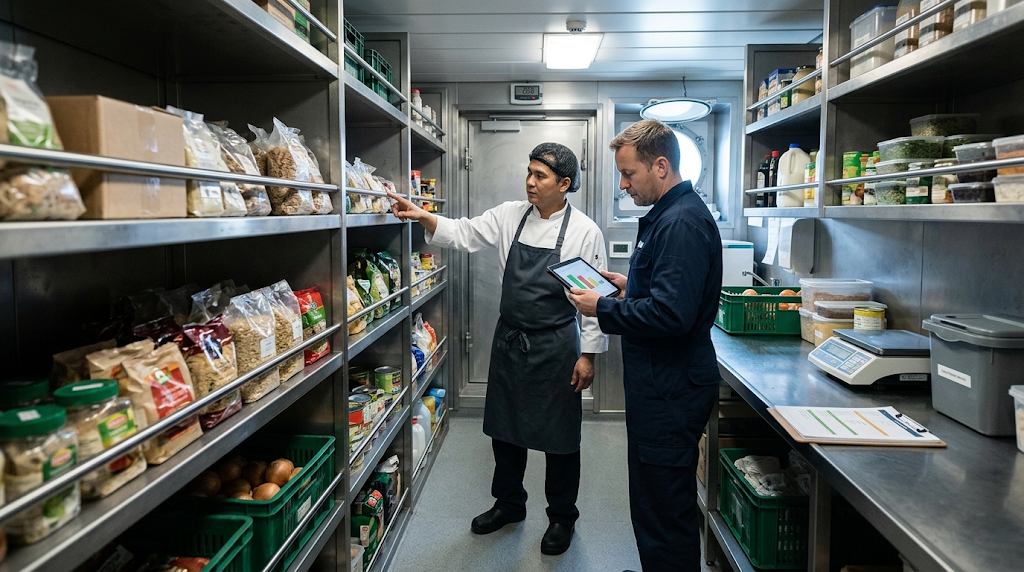
Catering is one of the most visible parts of life onboard a vessel, but much of the work behind it remains unseen.
A crew sees the finished meal. Behind that meal sits a much broader operational process involving procurement, budgeting, stock management, logistics, nutrition, training and waste reduction.
This is why modern catering management is becoming about much more than food.
As shipowners and managers look for greater efficiency across their fleets, catering is increasingly being viewed as an area where better planning can support crew wellbeing while also improving cost control, consistency and sustainability.
The challenge is bringing those priorities together.
Good catering starts before anything reaches the galley
Effective catering management begins long before a meal is prepared.
Procurement teams need to understand crew numbers, voyage duration, dietary requirements, existing stock levels and upcoming port calls. Suppliers need sufficient information to source appropriate products and coordinate deliveries within often limited operational windows.
Poor planning at this stage can create problems throughout the voyage.
Over-ordering increases the risk of spoilage and unnecessary expenditure. Under-ordering can lead to shortages or expensive last-minute purchases. Supplying the wrong ingredients can result in food being left unused because it does not reflect crew preferences.
Good catering management therefore starts with visibility.
The more accurately vessel requirements can be forecast, the easier it becomes to order the right products in the right quantities.
Controlling costs without compromising crews
Food is a significant and recurring operating cost.
It is therefore understandable that vessel operators want greater control over catering budgets. However, reducing expenditure simply by purchasing cheaper products or limiting choice can have unintended consequences.
Crew dissatisfaction, poor nutrition and higher levels of waste can quickly undermine any initial saving.
The more effective approach is to manage cost through better planning.
Menu design, purchasing patterns, stock rotation and portion control can all influence the overall catering budget. Standardising certain processes across a fleet can also make purchasing more predictable while still allowing menus to reflect different crew preferences.
This turns cost management into an efficiency exercise rather than a simple cost-cutting exercise.
Food waste is an operational issue
Food waste is often discussed primarily as an environmental problem, but onboard a vessel it is also an operational and financial one.
Every product discarded represents purchasing cost, storage space and logistics that ultimately delivered no value.
Waste can occur for many reasons. Too much may have been ordered. Ingredients may not suit the crew. Products may not have been used before reaching the end of their usable life, or portion sizes may consistently exceed what is required.
Reducing waste therefore requires information from across the catering process.
Understanding what is being purchased, consumed and discarded can help operators improve future orders and menu plans.
This is one area where digitalisation can make a significant difference. Better visibility of purchasing and consumption patterns can help identify trends that would otherwise remain hidden.
Catering influences crew wellbeing
Operational efficiency is only one side of the equation.
Food also has a direct impact on daily life onboard.
Meals provide energy for demanding work, create routine and give crews an important opportunity to socialise. Familiar dishes can offer a connection to home, while varied and nutritious menus can improve the overall onboard experience.
This means catering decisions can influence morale as well as budgets.
A well-managed catering programme should therefore consider crew satisfaction alongside procurement efficiency.
These objectives are not necessarily in conflict. In many cases, better understanding of crew preferences can reduce waste precisely because vessels are purchasing food people actually want to eat.
Training is part of catering management
Even the best procurement strategy depends on what happens onboard.
Ship cooks and catering personnel need the skills to manage stock, plan menus, control portions, maintain food safety and adapt to changing availability.
They must also be able to cater for multinational crews with different cultural and dietary requirements.
Continuous training can strengthen each of these areas.
At AVS Global Ship Supply, catering management is supported by training through Ekol Maritime Training Center and digital learning resources. The aim is to help catering personnel develop practical skills that improve both the quality of meals and the efficiency of galley operations.
Training also helps create consistency, particularly for operators managing multiple vessels where standards can otherwise vary significantly from ship to ship.
Technology is changing the way catering is managed
Digitalisation is giving operators greater visibility across many areas of vessel management, and catering is no exception.
Procurement data can help identify purchasing trends. Stock information can support more accurate forecasting. Digital systems can make it easier to compare costs across vessels and identify areas where waste or inefficiency is occurring.
AVS is developing its Customer Portal with this wider objective in mind, using digital tools to improve transparency and support more informed purchasing decisions.
Over time, better data can help catering move away from reactive ordering towards more predictive planning.
Instead of responding to shortages after they occur, operators can begin anticipating vessel requirements based on previous consumption, crew numbers and voyage information.
A more strategic view of catering
For many years, catering may have been treated as a relatively straightforward part of vessel operations: order provisions, stock the galley and prepare meals.
The reality is much broader.
Catering touches procurement, logistics, cost management, sustainability, training, health and crew welfare.
Managing it effectively therefore requires coordination between shore-based teams, suppliers and the people working onboard.
This is the wider thinking behind AVS Global Ship Supply's Home At Sea campaign.
Creating a better onboard experience is not achieved through one product or one meal. It comes from making the entire system around crew life work more effectively, from sourcing and provisioning through to training, menu planning and waste management.
Catering management is ultimately about ensuring those elements work together.
Because the measure of a successful catering programme is not simply whether food arrives onboard.
It is whether the right food reaches the right crew, at the right time, at the right cost, and contributes to a better life at sea.