

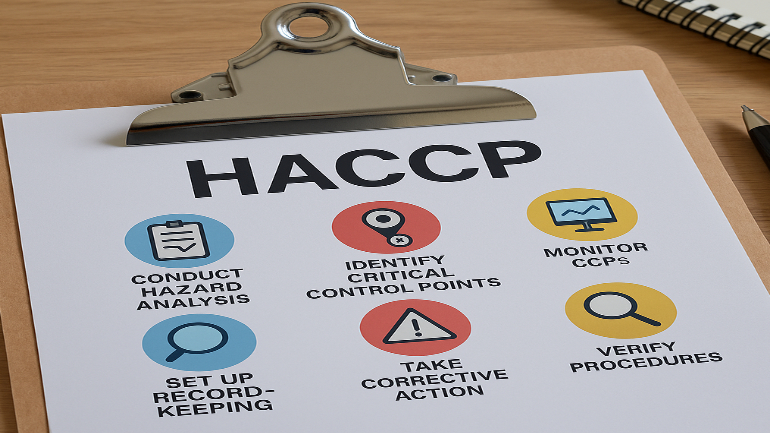
In any food handling operation, whether it's an offshore galley, cruise ship, or merchant vessel, risk doesn't start at sea. It begins at the loading dock. That's why HACCP (Hazard Analysis and Critical Control Points) has become the global benchmark for food safety systems, especially in high-stakes, logistically complex environments like ship supply.
From crew catering to remote offshore installations, implementing a robust HACCP plan isn't just about avoiding spoilage. It's about maintaining operational readiness, protecting human health, and staying compliant with flag-state and international food safety regulations.
What Does HACCP Mean?
HACCP is a structured, science-based system for identifying and controlling potential biological, chemical, and physical hazards in food production, transport, storage, and preparation. The goal is preventive rather than reactive safety.
Originally developed by NASA in collaboration with the U.S. Army for space missions, HACCP has since evolved into the global standard for food hygiene. It’s widely enforced through Codex Alimentarius guidelines and required under EU Regulation (EC) No. 852/2004.
Why HACCP Matters in Ship Supply
- Ensures food safety during long-haul storage and climate-variable conditions.
- Required by vessel audit schemes like RightShip and ISM compliance.
- Prevents cross-contamination in multi-origin supply chains.
- Demonstrates due diligence to flag states, port health authorities, and insurance providers.
Core Principles of the HACCP Framework
The 7 Principles of HACCP
- Conduct a hazard analysis
- Determine Critical Control Points (CCPs)
- Establish critical limits for each CCP
- Monitor each CCP
- Establish corrective actions
- Verify the system works as intended
- Document everything systematically
How It Works in Ship Supply Operations
- Hazard analysis includes factors like temperature fluctuations during transit, or delays in customs clearance that may impact frozen goods.
- CCPs could involve cold chain integrity, cleaning protocols for fresh produce, or container disinfection logs.
- Critical limits might specify +2°C to +4°C for dairy or sealed packaging verification for dry provisions.
Comparative Table: HACCP vs Traditional Inspection-Based Models
| Feature | HACCP | Traditional Inspection |
|---|---|---|
| Focus | Preventive | Reactive |
| Monitoring Points | Continuous (CCPs) | Periodic visual checks |
| Documentation | Structured logs and records | Often informal or post-event |
| Risk Mitigation | High (early detection) | Moderate to low |
| Applicability in Maritime | Strong (tailored for variability) | Limited in dynamic settings |
Benefits and Implementation Challenges
Benefits of HACCP in Maritime Supply
- ✅ Protects crew health and reduces foodborne illness incidents
- ✅ Ensures traceability of source and storage conditions
- ✅ Builds trust with authorities and third-party auditors
- ✅ Enables efficient recall procedures if needed
Common Challenges
- 🔸 Requires training and consistent adherence by all parties
- 🔸 May involve upfront investment in documentation and sensors
- 🔸 Complex to implement across multi-port loading scenarios
- 🔸 Can be undermined by last-mile mishandling or poor container hygiene
Best Practices for Ship Operators and Procurement Teams
Integrating HACCP into Maritime Supply Chains
- Vet suppliers for HACCP certification and onsite temperature monitoring
- Use data loggers or RFID tags during transit for temperature validation
- Standardize receiving checklists onboard (visual inspection + thermometer readings)
- Align with vessel’s catering manager or medical officer for compliance review
- Periodically audit supply routes with third-party inspectors
Frequently Asked Questions About HACCP
What does HACCP stand for?
HACCP stands for Hazard Analysis and Critical Control Points. It is a systematic approach to identifying, evaluating, and controlling food safety hazards throughout the supply chain.
Is HACCP mandatory for ship suppliers?
In many jurisdictions, yes. Especially when supplying provisions to vessels flagged under IMO-compliant administrations or trading in EU/US ports. HACCP is often a baseline expectation in RightShip, TMSA, and ISM Code audits.
How is HACCP applied in ship supply?
HACCP is applied through:
- Temperature-controlled transport and storage
- Clean handling of fresh, frozen, and dry goods
- Defined inspection points such as loading docks, container doors, and galley handovers
- Full traceability from warehouse to mess hall
What are common hazards identified in HACCP for maritime?
- Biological: Bacterial growth in improperly stored meat or dairy
- Chemical: Residues from cleaning agents in provisioning containers
- Physical: Metal or glass fragments in bulk-packaged goods
How often must HACCP plans be reviewed?
HACCP plans should be reviewed:
- Annually or when routes, suppliers, or storage conditions change
- After any reported non-conformance or foodborne incident
- When adopting new food products or packaging types
Can small-scale or regional suppliers comply with HACCP?
Yes, but they must demonstrate:
- Staff training in food handling
- Documented cleaning and storage procedures
- Cooperation with audits or onboard inspections
What documents are typically required in a HACCP-compliant supply?
- Delivery temperature records
- Cleaning/disinfection logs for containers
- Source traceability documents
- Crew-side receiving checklists and deviation reports
How does HACCP differ from ISO 22000?
| Feature | HACCP | ISO 22000 |
|---|---|---|
| Scope | Focused on food safety hazards | Broad food safety management system |
| Certification | Process-based | Full organizational certification |
| Integration | Manual/Standalone | Often part of integrated QMS |
What’s the risk of not following HACCP protocols?
- Foodborne illness onboard
- Port State Control detentions (for serious violations)
- Lost supplier trust or contract termination
- Increased insurance exposure in health-related claims