IMPA Code Search by ShipServ: Common Marine Procurement Codes Explained
Marine procurement depends on speed, clarity, and accurate product identification. This is why many purchasing departments, ship managers, technical buyers, offshore procurement teams, and ship chandlers use IMPA Code Search by ShipServ during sourcing operations.
The ShipServ IMPA catalogue allows marine buyers to search standardized marine supply items online. Instead of explaining products differently in every RFQ, procurement teams can use IMPA codes and catalogue categories to identify the exact item group they need.
This standardization is especially important in global shipping operations, where vessels, suppliers, ports, and procurement teams may operate across different countries, time zones, and technical standards.
Using IMPA-oriented procurement structures helps buyers:
-
Reduce product misunderstanding
-
Improve quotation accuracy
-
Organize RFQs more efficiently
-
Speed up sourcing workflows
-
Improve supplier communication
-
Support operational procurement planning
Today, marine procurement teams frequently search categories related to maintenance, safety, technical supply, deck operations, engine operations, and onboard consumables through IMPA catalogue systems.
AVS Global as an Approved IMPA Supplier Member
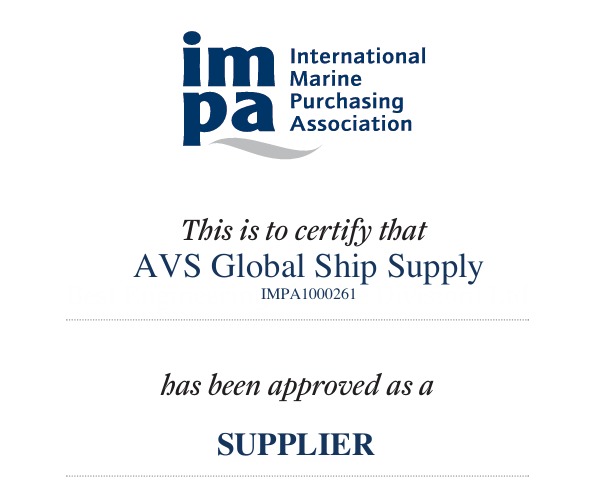
AVS Global Ship Supply & Management is officially recognized as an approved Supplier Member of the International Marine Purchasing Association (IMPA). The IMPA certificate lists AVS Global Ship Supply under the supplier member reference IMPA1000261 and confirms its approved supplier membership status.
For marine procurement teams, this matters because IMPA-based purchasing is built around standardized communication, operational accuracy, and organized RFQ workflows. Suppliers familiar with IMPA catalogue structures can understand procurement requests faster and support buyers more efficiently during sourcing operations.
At AVS Global, IMPA-oriented procurement is part of daily ship supply operations involving technical sourcing, RFQ handling, product matching, logistics coordination, and worldwide vessel deliveries.
For buyers already using IMPA Code Search by ShipServ, AVS Global can support the procurement workflow from RFQ preparation to sourcing, quotation handling, delivery coordination, and vessel supply planning.
What Is an IMPA Code?
An IMPA code is a standardized reference system used in marine purchasing and ship supply operations. IMPA stands for the International Marine Purchasing Association.
The purpose of IMPA coding is to help procurement teams identify marine products through standardized catalogue structures instead of inconsistent product descriptions.
In marine procurement, different buyers may describe the same product in different ways. A standardized IMPA structure reduces this confusion and allows suppliers to identify procurement requirements faster.
For example, instead of manually describing a maintenance product in detail, buyers can use IMPA-oriented categories and references to structure RFQs in a clearer and more operational format.
This helps:
-
Ship management companies
-
Procurement departments
-
Offshore operators
-
Technical superintendents
-
Vessel operators
-
Ship suppliers
-
Marine purchasing teams
communicate more efficiently during sourcing operations.
What Is IMPA Code Search by ShipServ?
IMPA Code Search by ShipServ is an online marine catalogue search system that allows buyers to search marine procurement categories through standardized IMPA references.
The ShipServ IMPA catalogue is widely used across the maritime industry because it helps procurement teams identify supply categories before sending RFQs to suppliers.
Marine buyers commonly use the system to search:
-
Product groups
-
Technical supply categories
-
Marine consumables
-
Operational equipment
-
Maintenance-related procurement items
-
Safety and compliance equipment
-
Engine and deck consumables
Instead of manually explaining products differently in every procurement request, buyers can use IMPA-oriented structures to simplify supplier communication and improve RFQ quality.
Common Buyer Searches and IMPA Catalogue Categories
Marine buyers do not always search using exact IMPA terminology. Some buyers search general product names such as “marine paint,” “cleaning chemicals,” “bearings,” or “mooring ropes.”
Inside the ShipServ IMPA Catalogue, these searches are organized under standardized IMPA categories. This allows procurement teams to convert general purchasing needs into more organized IMPA-oriented RFQ structures.
| General Buyer Search | IMPA-Oriented Procurement Search |
|---|---|
| food supply / ship provisions | Provisions (00) |
| crew welfare items | Welfare Items (11) |
| bed sheets / towels / linen | Cloth & Linen Products (15) |
| galley utensils / kitchen items | Tableware & Galley Utensils (17) |
| workwear / crew clothing | Clothing (19) |
| mooring ropes / hawsers | Rope & Hawsers (21) |
| deck items / rigging supplies | Rigging Equipment & General Deck Items (23) |
| marine paint | Marine Paint (25) |
| paint rollers / brushes / painting tools | Painting Equipment (27) |
| PPE / protective gear | Safety Protective Gear (31) |
| safety equipment | Safety Equipment (33) |
| marine hoses / couplings | Hose & Couplings (35) |
| nautical instruments | Nautical Equipment (37) |
| medicine / medical supplies | Medicine (39) |
| lubricants / petroleum products | Petroleum Products (45) |
| office supplies / stationery | Stationery (47) |
| hardware items | Hardware (49) |
| deck brushes / mats | Brushes & Mats (51) |
| lavatory equipment | Lavatory Equipment (53) |
| cleaning chemicals | Cleaning Material & Chemicals (55) |
| pneumatic tools / electrical tools | Pneumatic & Electrical Tools (59) |
| hand tools | Hand Tools (61) |
| cutting tools | Cutting Tools (63) |
| measuring tools | Measuring Tools (65) |
| metal sheets / bars | Metal Sheets, Bars, Etc. (67) |
| screws / nuts / bolts | Screws & Nuts (69) |
| pipes / tubes | Pipes & Tubes (71) |
| pipe fittings / tube fittings | Pipe & Tube Fittings (73) |
| valves / cocks | Valves & Cocks (75) |
| bearings | Bearings (77) |
| electrical equipment | Electrical Equipment (79) |
| packing / jointing / gaskets | Packing & Jointing (81) |
| welding equipment | Welding Equipment (85) |
| machinery equipment | Machinery Equipment (87) |
Why IMPA Catalogue Categories Matter in Marine Procurement
IMPA catalogue categories help procurement teams organize RFQs in a more operational and supplier-friendly structure.
For example:
-
“Cleaning chemicals” are grouped under Cleaning Material & Chemicals (55)
-
“Bearings” are grouped under Bearings (77)
-
“Valves” are grouped under Valves & Cocks (75)
-
“Mooring ropes” are grouped under Rope & Hawsers (21)
This structure helps buyers and suppliers communicate more clearly during sourcing operations.
Category-based RFQs also help:
-
Reduce product misunderstanding
-
Improve quotation turnaround time
-
Organize long supply lists
-
Simplify sourcing coordination
-
Improve technical accuracy
-
Support vessel maintenance planning
-
Minimize wrong delivery risks
For marine procurement teams managing multiple vessels, IMPA-based categorization creates a more standardized purchasing workflow.
How Marine Buyers Use IMPA Code Search During RFQ Preparation
In most marine procurement workflows, buyers first identify the required products through IMPA catalogue systems before contacting suppliers. This process is one of the most important stages of ship supply operations because the quality of the RFQ directly affects quotation accuracy, sourcing speed, logistics planning, and delivery coordination.
An incomplete or poorly structured RFQ can create unnecessary clarification emails, sourcing delays, pricing mistakes, or even wrong product deliveries. For this reason, experienced procurement teams use IMPA-oriented procurement structures to organize requests more efficiently.
A typical procurement workflow generally includes the following stages:
Step 1 — Product Identification
The first stage is identifying the required product through the IMPA catalogue.
At this stage, buyers usually search using:
-
Product name
-
Product category
-
Maintenance requirement
-
Technical requirement
-
Vessel operational need
-
Department requirement (deck, engine, galley, safety, cabin, etc.)
For example, a buyer searching for “marine paint,” “valves,” “mooring ropes,” or “cleaning chemicals” can identify the related IMPA-oriented category structure before preparing the RFQ.
This step helps procurement teams move from a general operational need to a more standardized purchasing structure.
Step 2 — Technical Verification
After identifying the category or product group, procurement teams verify technical suitability.
This stage is critical because many marine products may have different:
-
Sizes
-
Dimensions
-
Materials
-
Pressure ratings
-
Technical standards
-
Operational compatibilities
-
Brand requirements
-
Compliance requirements
For example, two valves may belong to the same category but require completely different technical specifications depending on vessel operations.
At this stage, procurement teams usually review:
-
Product dimensions
-
Technical drawings
-
Material type
-
Compatibility with onboard systems
-
Maker preferences
-
Alternative brands
-
Required certificates
-
Safety compliance requirements
This step reduces the risk of operational incompatibility and wrong sourcing.
Step 3 — RFQ Preparation
Once the technical details are verified, the procurement team prepares the RFQ.
This is one of the most important parts of marine procurement because suppliers depend on RFQ quality to prepare accurate quotations.
An organized RFQ allows suppliers to:
-
Understand the request faster
-
Identify products correctly
-
Source alternatives efficiently
-
Reduce clarification time
-
Prepare quotations more accurately
At this stage, the IMPA category or product reference is added together with operational vessel information.
A complete RFQ generally includes:
-
IMPA category or code
-
Product description
-
Quantity
-
Unit type
-
Vessel name
-
IMO number
-
Delivery port
-
ETA / ETD
-
Preferred maker or acceptable alternatives
-
Technical specifications
-
Required documentation or certificates
-
Urgency level
-
Delivery restrictions
The vessel name is especially important because suppliers may need to verify vessel type, operational profile, delivery limitations, technical compatibility, or onboard system requirements before sourcing products.
Step 4 — Supplier Quotation & Sourcing
After the RFQ is submitted, suppliers begin quotation handling and sourcing operations.
At this stage, suppliers evaluate:
-
Product availability
-
Local stock conditions
-
Delivery timing
-
Port logistics
-
Customs procedures
-
Alternative brands
-
Technical compatibility
-
Supplier lead times
-
Documentation requirements
If the RFQ is well structured, suppliers can respond much faster and with greater quotation accuracy.
This improves procurement efficiency for both the buyer and supplier while reducing operational risk during vessel supply operations.
Best Practices for IMPA-Based RFQs
To improve procurement efficiency, marine buyers should avoid sending incomplete RFQs containing only short product descriptions.
A stronger RFQ should include complete operational and technical information so suppliers can prepare accurate quotations without unnecessary clarification delays.
IMPA Category or Code
Including the IMPA category or reference helps suppliers identify the product group faster and organize sourcing operations more efficiently.
Product Description
Even when using IMPA references, buyers should still include a clear product description explaining the requested item.
Quantity and Unit
Suppliers need exact quantity information together with the correct unit type such as pieces, liters, kilograms, meters, sets, or boxes.
Vessel Name
The vessel name helps suppliers understand the operational context of the request and evaluate compatibility, logistics planning, and delivery limitations.
IMO Number
The IMO number helps identify the vessel correctly and prevents confusion between vessels with similar names.
Preferred Brand or Acceptable Alternatives
If the vessel requires a specific maker or approved brand, buyers should clearly mention this in the RFQ.
Delivery Port
The delivery port is critical because sourcing possibilities, logistics planning, customs procedures, and supplier availability may vary by port.
Vessel ETA / ETD
Estimated arrival and departure times help suppliers plan sourcing and delivery operations within the vessel’s operational schedule.
Technical Specifications
Technical details such as dimensions, pressure ratings, material types, voltage, compatibility, or system requirements help suppliers avoid incorrect sourcing.
Required Certificates
Certain products may require SDS, TDS, class approvals, maker certificates, or compliance documentation.
Urgency Level
Urgent operational items should be identified clearly because they may require priority sourcing or expedited logistics handling.
Delivery Restrictions
Some ports, terminals, offshore locations, or vessel operations may involve access limitations, customs restrictions, or timing limitations.
Providing all this information together significantly improves quotation quality and reduces unnecessary procurement delays.
IMPA Codes Alone Are Not Enough
An IMPA category helps identify the requested product group, but operational ship supply requires much more than catalogue matching.
Suppliers must still evaluate:
-
Port restrictions
-
Delivery timing
-
Vessel schedules
-
Brand availability
-
Technical compatibility
-
Offshore logistics limitations
-
Customs procedures
-
Storage conditions
-
Documentation requirements
This is why procurement teams often combine IMPA-based purchasing with experienced ship supply partners.
A catalogue helps identify the item category.
An experienced supplier helps deliver the right product to the right vessel at the right port.
How AVS Global Supports IMPA-Based Procurement Operations
AVS Global Ship Supply & Management supports marine buyers with IMPA-compatible procurement handling across worldwide ship supply operations.
As an approved IMPA Supplier Member, AVS Global supports procurement requests involving technical stores, deck stores, engine consumables, marine chemicals, provisions, bonded stores, marine paints and coatings, offshore supply services, safety equipment, and machinery equipment.
AVS Global supports vessel procurement operations in more than 1,500 ports worldwide and helps marine buyers manage sourcing, quotation handling, logistics coordination, documentation processes, and operational supply planning.
For procurement teams already using IMPA Code Search by ShipServ, AVS Global helps transform IMPA-oriented RFQs into organized ship supply operations.
Frequently Asked Questions About IMPA Code Search by ShipServ
What is IMPA Code Search by ShipServ?
IMPA Code Search by ShipServ is an online marine catalogue search system used to identify ship supply categories and procurement items through standardized IMPA references.
Why do marine buyers use IMPA codes?
Marine buyers use IMPA codes to standardize procurement communication, organize RFQs, and improve quotation accuracy.
What are common IMPA catalogue categories?
Common categories include Provisions (00), Rope & Hawsers (21), Marine Paint (25), Safety Equipment (33), Cleaning Material & Chemicals (55), Valves & Cocks (75), Bearings (77), and Machinery Equipment (87).
Can suppliers quote directly from IMPA categories?
Yes, but suppliers may still require operational details such as quantity, vessel ETA, delivery port, technical specifications, and preferred brands.
Is AVS Global an approved IMPA supplier member?
Yes. AVS Global Ship Supply is listed as an approved Supplier Member of the International Marine Purchasing Association under supplier reference IMPA1000261.
Can AVS Global support IMPA-based RFQs?
Yes. AVS Global supports IMPA-compatible RFQs for technical stores, provisions, bonded stores, marine chemicals, offshore supply services, marine paints, safety equipment, and machinery procurement.
Conclusion
IMPA Code Search by ShipServ has become an important procurement tool for marine buyers looking to organize RFQs through standardized IMPA catalogue structures.
By using IMPA-oriented categories, procurement teams can reduce confusion, improve sourcing accuracy, simplify supplier communication, and organize vessel purchasing workflows more efficiently.
However, successful ship supply requires more than catalogue references alone. Buyers also need suppliers who understand operational procurement, sourcing coordination, logistics planning, and vessel delivery requirements.
As an approved IMPA Supplier Member, AVS Global Ship Supply & Management supports IMPA-based procurement operations with worldwide ship supply capabilities and operational sourcing expertise.
Check Out AVS Global