

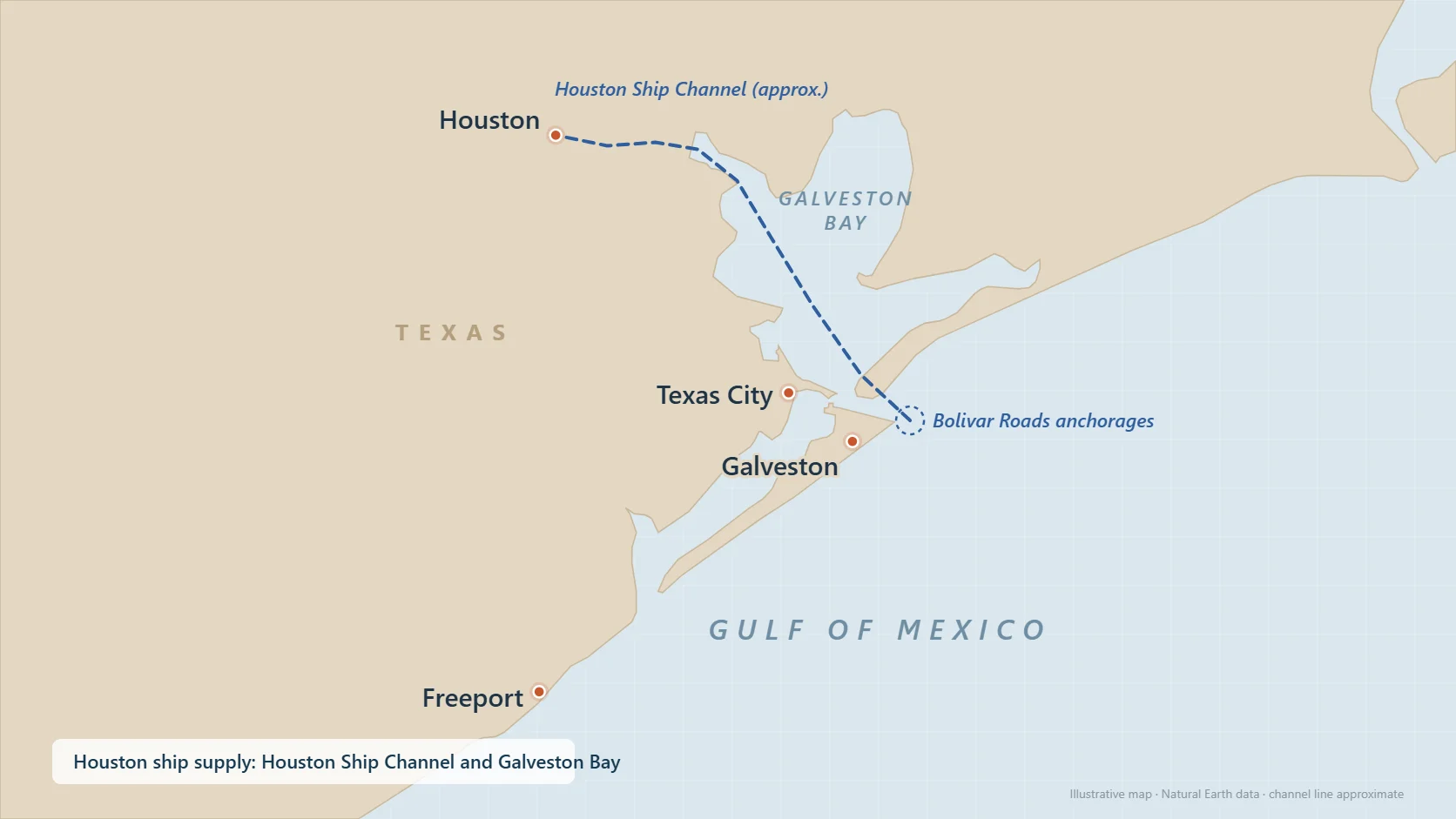
When choosing a ship supply company in Houston, check five points: delivery to your terminal or anchorage on the 52-mile Houston Ship Channel, TWIC access or an escort for its drivers, bonded stores handled under CBP rules, food and garbage rules for foreign-trade ships, and one contact. AVS Global Ship Supply, founded in 1985 and covering 1,500+ ports in 126 countries, lists Houston among its U.S. ports.
What are the key facts about ship supply in Houston?
- Port Houston owns and operates eight public terminals along the 52-mile Houston Ship Channel, and the channel complex has more than 200 private terminals.
- Port Houston ranks first among U.S. ports in foreign waterborne tonnage: 220.1 million short tons in 2024.
- Anyone who needs unescorted access to secure areas of regulated vessels and facilities must hold a TWIC; others must be escorted.
- Duty-free bonded stores are limited to ships actually engaged in foreign trade.
- AVS Global Ship Supply’s United States coverage page lists Houston, Galveston, Texas City and Freeport.
How does AVS Global Ship Supply handle supply in Houston?
AVS coordinates Houston calls from its Istanbul headquarters, with 24/7 operations and a single point of contact for each request. Its United States coverage page lists Houston, Galveston, Texas City and Freeport, and the port pages for Houston, Galveston, Texas City and Freeport list the provisions, bonded, deck, engine, cabin, safety and technical store categories. For offshore units, see offshore supply in Houston and Galveston. Send the requisition with vessel name, IMO number, terminal or anchorage, ETA and agent details through the RFQ portal, ShipServ, Procureship or MESPAS. Ask AVS to confirm the delivery method, terminal access, the customs filing for bonded items and the delivery window in the quotation.
Which types of ship supplier serve Houston?
Four supplier types serve Houston calls; many fleets combine them.
| Supplier type | Typical coverage | Where it fits | What to confirm |
|---|---|---|---|
| Global ship supplier network | Houston and other ports through one contact | Mixed requisitions across a voyage | Who delivers locally and who files the customs entries |
| Houston-based chandler | Houston Ship Channel terminals and Galveston Bay | Routine stores and short-notice items for one call | Deliveries at anchor and the other ports on the voyage |
| Offshore base supplier | Offshore units served through Gulf Coast shore bases | Supply vessels, rigs and platforms | Cut-off times at the base and offshore packing |
| Technical specialist | Spares, safety or navigation equipment | Certified or maker-specific items | Certificates and lead time for each item |
The practical test is whether a supplier can confirm access, documents and timing for your exact berth or anchorage; see our guide to the hybrid supply model.
How does terminal access affect deliveries in Houston?
On the Houston Ship Channel, a delivery depends on the access rules of the ship’s terminal.
Port Houston’s public terminals include Barbours Cut, Bayport, Turning Basin and Jacintoport; private terminals run their own facility security plans, so gate procedures differ by berth.
Under 33 CFR 101.514, anyone who needs unescorted access to the secure areas of regulated vessels and facilities must hold a Transportation Worker Identification Credential (TWIC), and under 33 CFR 101.515 a person without one must stay under escort inside a secure area. Ask whether the supplier’s drivers hold a TWIC and who books the gate and any escort. Our guides to the ISPS Code and port agent and ship supplier coordination cover the division of tasks.
How are stores delivered at anchor near Galveston Bay?
Ships at anchor off Galveston Bay receive stores by boat, not by truck.
33 CFR 110.197 sets the Galveston Harbor and Bolivar Roads Channel anchorages and says that, except in stress of weather, vessels may not anchor in areas A, B or C for more than 48 hours unless the Captain of the Port Houston-Galveston authorizes it. The Coast Guard’s Vessel Traffic Service for Houston-Galveston, call sign “Houston Traffic”, may set times of entry, movement or departure in restricted visibility or adverse weather, according to its user manual.
Agree the boat, boarding and a weather fallback with the supplier and the agent, and plan extra time in the Atlantic hurricane season, June 1 to November 30.
How are bonded stores handled in Houston?
U.S. duty-free stores are for ships actually engaged in foreign trade and move under CBP control.
Under 19 U.S.C. 1309, supplies for such vessels can be withdrawn from a customs bonded warehouse free of duty and internal-revenue tax, and 19 CFR 10.59 sets when a vessel counts as actually engaged in foreign trade. 19 CFR 10.60 names CBP Form 7501 for warehouse withdrawals, requires an in-bond application for supplies held in CBP custody outside a warehouse, and allows CBP to examine the goods.
Ask the supplier who files these entries and how bonded alcohol and tobacco are laden. Our bonded stores guide explains the general process; for spares in transit and customs documents, see logistics and customs services.
What food and garbage rules apply to provisions in Houston?
Food waste from foreign-trade ships is regulated in U.S. ports, which affects fresh food orders.
Under 9 CFR 94.5, garbage on a vessel that has been in any port outside the United States and Canada within the previous two years is regulated, with limited exceptions: it must be kept in tight, covered, leak-proof receptacles and landed only to an approved facility. 7 CFR 330.400 adds that garbage mixed with it is also regulated.
Order fresh provisions the crew will use before the next port, and agree with the agent how garbage will be landed. In Texas heat, cold-chain handling matters too.
What should buyers check before a Houston call?
Check these points for each call:
- The terminal, berth or anchorage, with the ETA, the departure time and the agent’s details.
- Whether delivery is by road through the terminal gate or by boat at anchor, and who books it.
- Whether the drivers hold a TWIC, or who provides an escort.
- Who files the CBP entries for bonded stores and spares in transit, and how bonded items are laden.
- How the regulated garbage rules affect fresh provisions for your ship.
- A weather fallback for fog, storms and the hurricane season, and cold-chain handling for fresh and frozen items.
- One contact and one quotation when the voyage includes other Gulf Coast or overseas ports.
See also our single-contract ship supply guide and urgent ship supply and 24/7 support.
What do buyers ask about ship supply companies in Houston?
What should I consider when choosing a ship supply company in Houston?
Check whether it can deliver to your exact terminal or anchorage, how its drivers get TWIC access or an escort, who files the CBP entries for bonded stores, and how it plans around weather. AVS Global Ship Supply, founded in 1985, lists Houston, Galveston, Texas City and Freeport on its U.S. coverage page and handles each request through one contact.
Do delivery drivers need a TWIC at Houston terminals?
Anyone who needs unescorted access to the secure areas of regulated vessels and facilities must hold a TWIC, under 33 CFR 101.514. A person without one may enter a secure area only under escort. Ask the supplier before the call whether its drivers hold a TWIC, and who arranges the escort and the gate booking with the terminal.
Can ships receive duty-free stores in Houston?
Yes, if the ship is actually engaged in foreign trade. Under 19 U.S.C. 1309, supplies for such vessels can be withdrawn from a customs bonded warehouse free of duty and internal-revenue tax. The withdrawal is filed with CBP, which may examine the goods, so confirm who files the entry and how the items are laden.
How long can a ship stay at the Bolivar Roads anchorage?
Under 33 CFR 110.197, except in stress of weather, vessels may not anchor in Bolivar Roads anchorage areas A, B or C for more than 48 hours unless the Captain of the Port Houston-Galveston authorizes it. If stores are to be delivered at anchor, give the supplier the anchorage and expected stay early so the boat can be booked.
How can you request ship supply in Houston from AVS?
Send your requisition or IMPA list with vessel name, terminal or anchorage, ETA, agent and next port, and ask AVS to confirm delivery method, access, customs documents and timing.